


Heat Shrink Technology – Applications in Electrical Engineering
Development of materials engineering, particularly our understanding of polymerisation and catalysis mechanisms, have made it possible to design and manufacture polymer compounds with properties precisely tailored to specific applications. Due to their exceptional characteristics, polymers are now used in virtually every area of life. In electrical engineering, their insulating properties are of primary importance, although their mechanical and chemical properties are equally significant.
The development of heat-shrinkable polymers has opened up new possibilities and led to the introduction of a wide range of heat-shrinkable products.
Heat-Shrink Properties of Materials
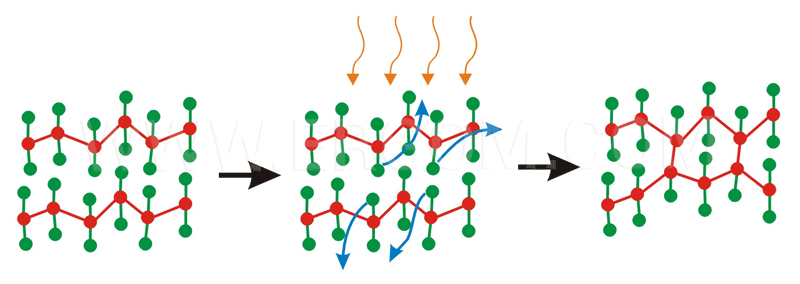
Heat shrinkage is the ability of a material to contract when exposed to heat. In polymers, this property can be achieved by converting their long carbon chains into a cross-linked network structure. When exposed to high-energy radiation, hydrogen atoms are removed from the carbon chains, allowing bonds to form between adjacent chains and creating a three-dimensional network.
Polymers are thermoplastic materials whose shape can be changed, or which can be stretched at elevated temperatures. Once cross-linked and stretched, they exhibit a shape-memory effect: when heated, the material shrinks towards its original dimensions. The degree of cross-linking determines the material's properties, including its shrink ratio and stiffness.
Polyolefins, particularly polyethylene, are commonly used for electrical insulation due to their good electrical and mechanical properties, including strength and flexibility over a wide temperature range, as well as their reasonable cost.
Applications of Heat Shrink Technology in Electrical Engineering
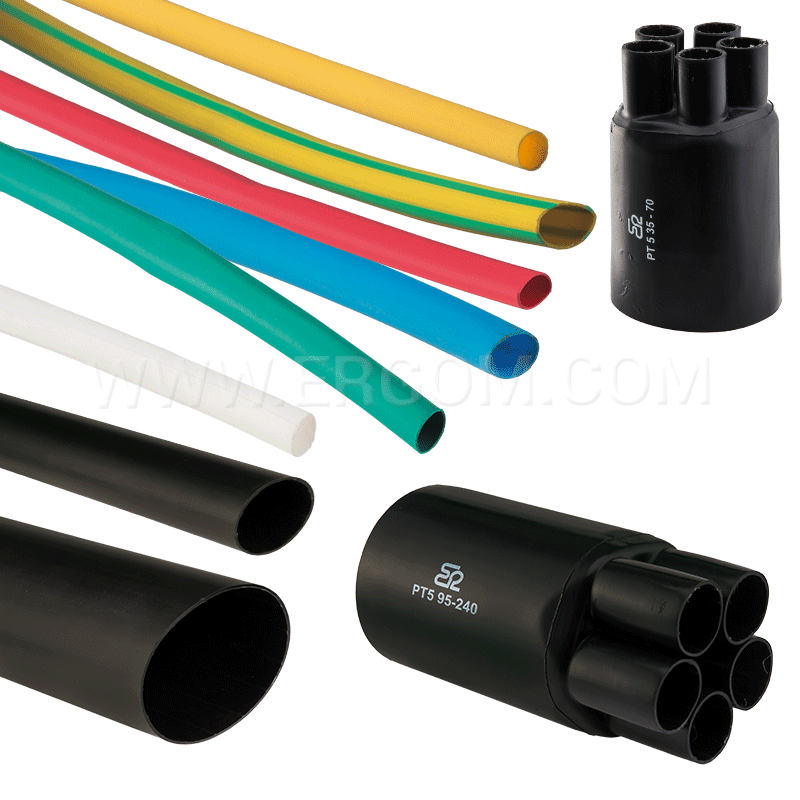
A wide range of products for low-, medium- and high-voltage applications is currently available on the electrical components market. Heat-shrinkable materials are used primarily for cable insulation and protection, with tubing being the most common product form.
The market offers heat-shrink tubing with and without adhesive, supplied in one-metre lengths or on reels and available in various colours. Other product forms include end caps, panels, breakout and heat-shrink tapes. Heat-shrinkable materials are also used to manufacture identification sleeves for marking wires and cables.
How Are Heat-Shrink Components Manufactured to Specific Shapes and Dimensions?
A thermoplastic material (polymer), once heated to an appropriate temperature, is pre-shaped by means of pressing or injection molding. The resulting component is then cross-linked through irradiation so that it retains its shape and dimensions in its material memory.
Next, the component is reheated and mechanically formed, for example by stretching, to give it a shape that allows it to be fitted over the object to be protected.
In the next stage, heating activates the material's shape memory, causing the component to shrink back towards its original shape or conform to the shape of the object onto which it has been fitted.
When a heat-shrink sleeve is correctly selected, it forms a tightly fitting layer around the protected object, providing electrical insulation, mechanical protection, corrosion protection and sealing. Some heat-shrink products are coated internally with hot-melt adhesive to improve the sealing performance of the resulting insulation.
Shrink Ratio
The primary parameter used to describe a heat-shrinkable material is its shrink ratio (Table 1), which expresses the ratio between the component's diameter before and after shrinking.
Heat-shrink products used in electrical engineering typically have shrink ratios ranging from 2:1 to 6:1. A lower shrink ratio of 1.5:1 is used for heat-shrink tapes, where shrinkage is primarily intended to achieve an adequately sealed covering.
Materials with higher shrink ratios, typically 4:1 to 6:1, are more versatile because they can accommodate a wider range of diameters. However, they are also considerably more expensive. They are particularly useful for emergency repairs and field applications where the required diameter range of the components to be insulated cannot be determined precisely in advance.
Dielectric Strength and Volume Resistivity
Materials with high electrical performance parameters, such as dielectric strength and volume resistivity, are used to insulate live components.
For low-voltage applications, polyethylene is a commonly used material. Its dielectric strength typically ranges from 10 to 18 kV/mm, while its volume resistivity is approximately (10^{12}) Ω·m.
For medium-voltage applications, modified polyolefins containing stabilisers and antioxidants are used. These additives improve the material's resistance to phenomena characteristic of medium-voltage systems, such as tracking. The dielectric strength of such materials should typically range from 24 to 36 kV/mm, with volume resistivity in the order of (10^{15}) Ω·m.
Heat Shrinking Process
The key to achieving high-quality protection with heat-shrinkable materials is selecting the appropriate heating equipment to ensure the correct shrinking temperature. For typical heat-shrink materials, the shrinking temperature should be between 100°C and 200°C.
Thin-wall materials are shrunk using electric or gas-powered heat guns.
For larger components and materials with thicker walls, such as panels, breakout, cable joints and terminations with diameters of approximately 40 mm or more, propane/butane gas heating equipment or torches are recommended.
Shrinking a component can change all its dimensions. As the diameter of the heat-shrink sleeve decreases, its length increases. Sufficient clearance must therefore be provided to prevent wrinkling or folding of the material.
For the same reason, it is important to choose the correct starting point for the shrinking process. The material may elongate in both directions, depending on its length and the shrinking technique used.
With its extensive range of heat-shrinkable materials meeting the required quality standards, together with dedicated heating tools, ERGOM provides comprehensive solutions at competitive prices.
ERGOM offers the following heat-shrink products: thin-wall and thick-wall tubing, end caps, breakout, heat-shrink panels, tapes, straight-through cable joints and reducing components.